L. fricii is morphologically distinguished from L. williamsii by flattened tubercles, 'diffuse' boundaries between adjacent ribs, a lack of prominent raised ribs, an unusual color, and horizontal…
L. fricii is morphologically distinguished from L. williamsii by flattened tubercles, 'diffuse' boundaries between adjacent ribs, a lack of prominent raised ribs, an unusual color, and horizontal 'double-chin' basal folds of tissue around larger stems; in these traits it is more similar to L. diffusa than to L. williamsii. [Terry 2008 CSJ 80 part 1 (Lophophora taxonomy)]
The accepted name with authority is Lophophora fricii Habermann, formally described by Habermann in 1975 (Habermann, V. 1975: 'Lophophora fricii Habermann species nova', Kaktusy 10: 123-127). [Hansen 2000 — Lophophora fricii & williamsii var. decipiens]
The habit of L. fricii differs markedly from that of L. williamsii and L. diffusa; epidermis color varies from green through grey-green to grey-blue. [Hansen 2000 — Lophophora fricii & williamsii var. decipiens]
Bodies of L. fricii are softer, reach up to 12 cm in diameter, and tend to shrink strongly during the growth-rest period. [Hansen 2000 — Lophophora fricii & williamsii var. decipiens]
Older plants of L. fricii usually have 13 ribs, though occasionally more; ribs may run straight downward, have strongly twisted longitudinal furrows, or be indistinct giving a more tessellated (gefelderte) structure. [Hansen 2000 — Lophophora fricii & williamsii var. decipiens]
The hair tufts (areole wool) of L. fricii are often more felted, shorter, and browner in color than in other Lophophora. [Hansen 2000 — Lophophora fricii & williamsii var. decipiens]
Even one- to two-year-old L. fricii differ from other Lophophora by their early-formed higher rib count; many seedlings up to more than 2 cm diameter bear small spines, otherwise seen only in hybrids or L. williamsii fa. jourdaniana. [Hansen 2000 — Lophophora fricii & williamsii var. decipiens]
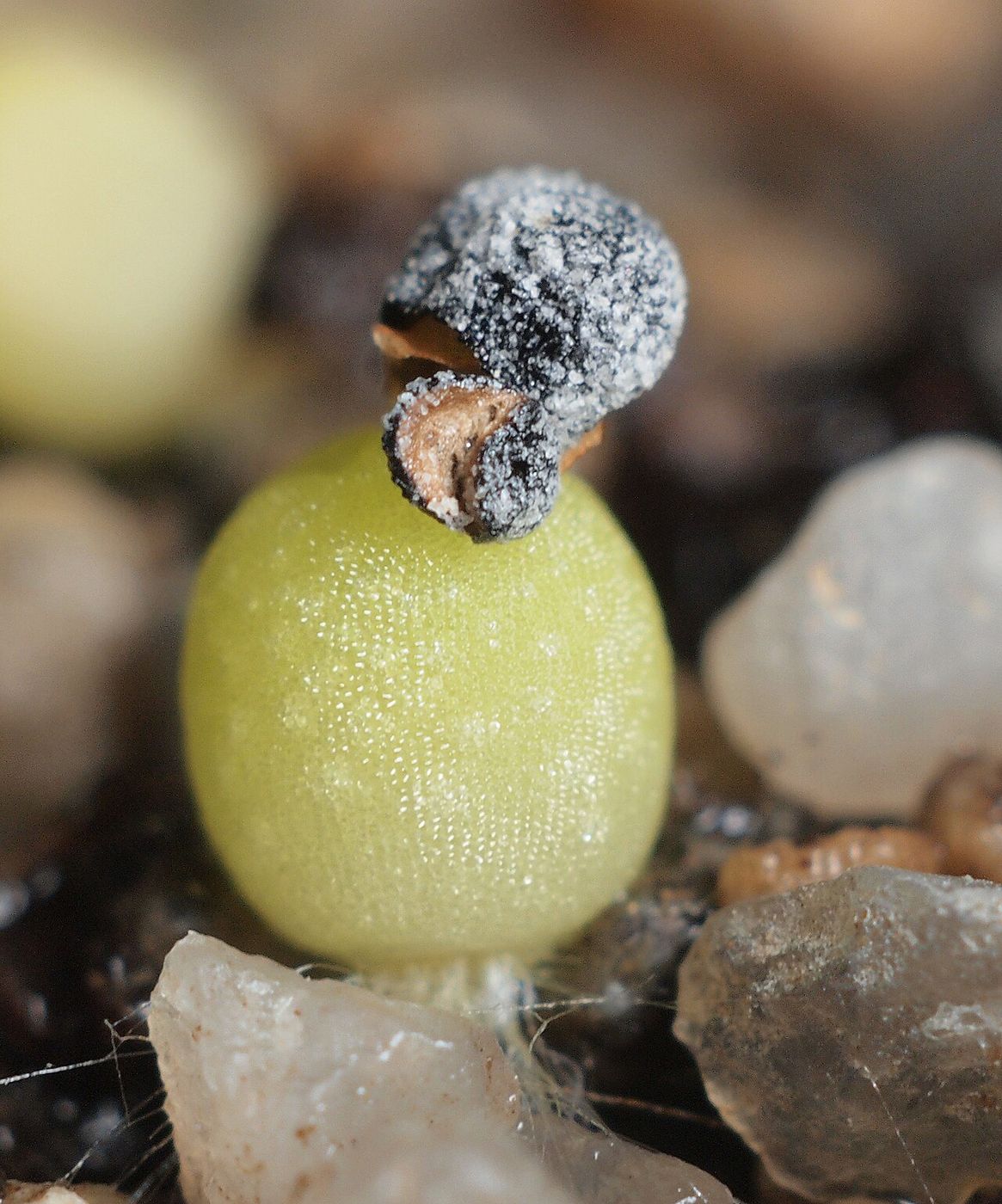
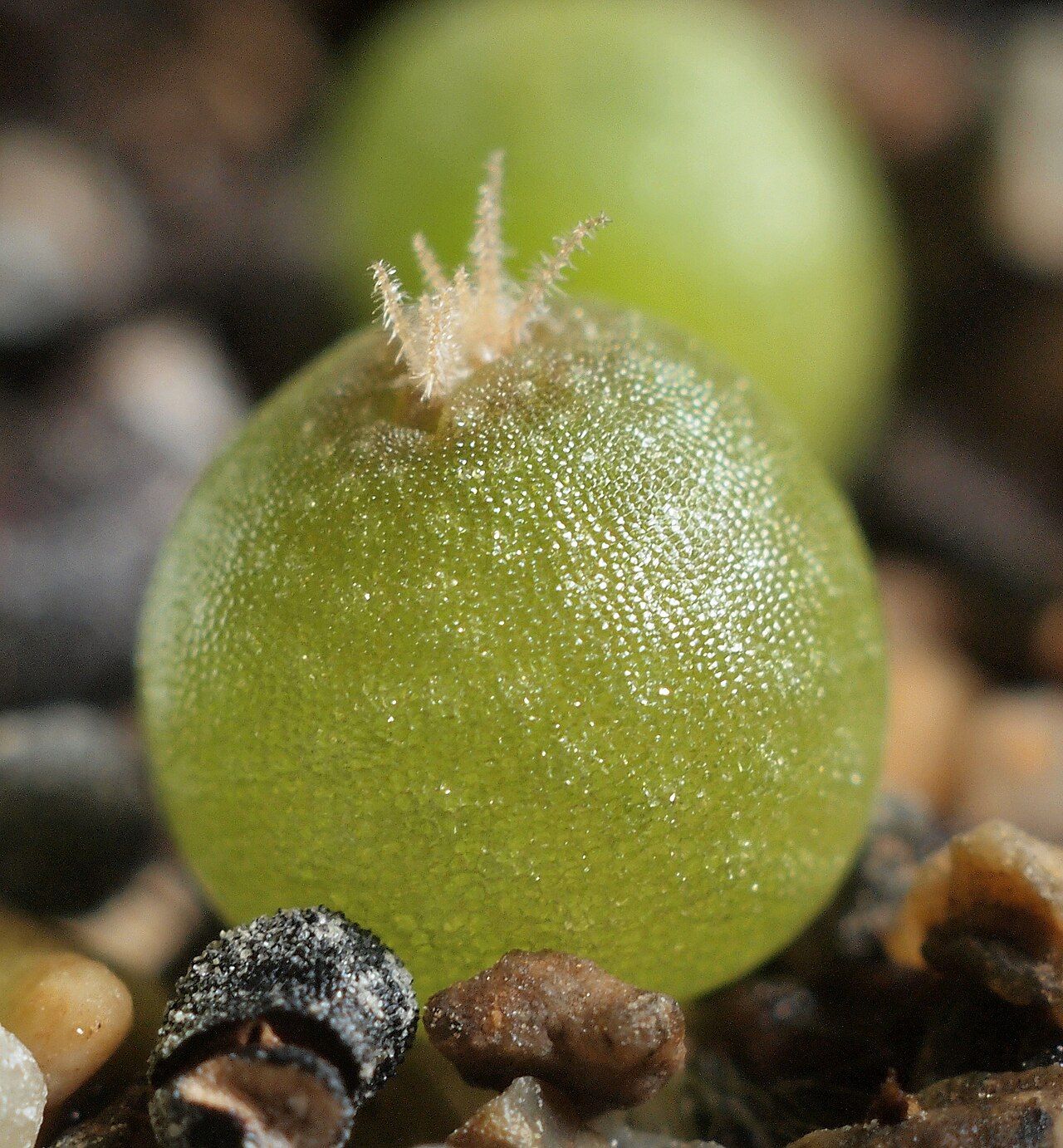
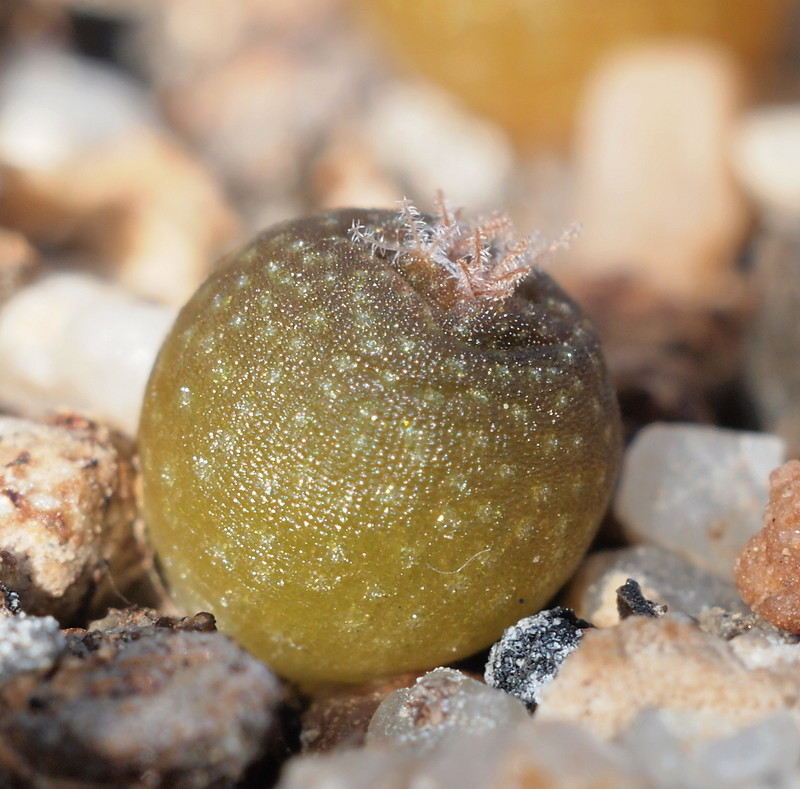
A distinguishing feature of L. fricii is the markedly different seed-coat (testa) structure; testa sculpture differs clearly among L. williamsii, L. diffusa, L. diffusa var. koehresii, and L. fricii (Hansen 1996, Grym 1997). [Hansen 2000 — Lophophora fricii & williamsii var. decipiens]
One plant (Abb. 21) with predominantly tessellated ribs has testa sculpture intermediate between L. williamsii and L. fricii — an elongated cell with a strongly cone-shaped bulge in the middle — yet based on habit (not unusual for plants at the Viesca locality) it is still assigned to L. fricii. [Hansen 2000 — Lophophora fricii & williamsii var. decipiens]
Petal shape varies: intensely pink-flowered plants often have rounded petals, while plants with larger flowers may have lanceolate petals; juvenile habit can differ substantially from that of older plants. [Hansen 2000 — Lophophora fricii & williamsii var. decipiens]
L. fricii is a red-flowered Coahuilan species with a different alkaloid profile; some plants once misattributed to many-ribbed L. williamsii are now believed to actually be L. fricii. [Trout's Notes on the Cultivation & Propagation of Cacti]
Lophophora fricii was described by Habermann (author abbrev. 'Haberm.'), first published in Kaktusy (Brno) 10: 123 (1975); POWO accepts it as a species while some authors treat it as L. diffusa subsp. fricii (Haberm.) Halda or L. williamsii var. fricii (Haberm.) Grym. [https://powo.science.kew.org/taxon/urn:lsid:ipni.org:names:134093-1]
Native range
L. fricii occurs at several spots around the perimeter of the Laguna de Viesca, a dry depression in southwest Coahuila that can become an ephemeral shallow lagoon during the rainy season, near the town of Viesca. [Terry 2008 CSJ 80 part 1 (Lophophora taxonomy)]
The range of L. fricii is bounded roughly by the area between San Pedro, Parras, and the eastern border of the state of Zacatecas (Grym 1997; map in Hansen 1998: 170). [Hansen 2000 — Lophophora fricii & williamsii var. decipiens]
Lophophora fricii is native to northeastern Mexico, in the state of Coahuila, occurring in desert and dry shrubland habitat. [https://powo.science.kew.org/taxon/urn:lsid:ipni.org:names:134093-1]
Habitat
Two distinct habitat forms of L. fricii occur at the Laguna de Viesca: a montane form growing in crevices of a hard limestone on the southwest mountainside, and a lowland form growing in loose, silty, alluvial (light-colored) soil with no apparent limestone influence on the northeastern flats among mesquite, creosote (Larrea), and small agaves. [Terry 2008 CSJ 80 part 1 (Lophophora taxonomy)]
At the Laguna de Viesca montane site most L. fricii plants are solitary (single-headed/single-stemmed). [Terry 2008 CSJ 80 part 1 (Lophophora taxonomy)]
Plants identified as L. fricii occur in higher-elevation parts of the Viesca area, whereas plants labeled L. williamsii var. decipiens occur particularly in the lowland flats of the Laguna de Viesca (G. Kohres, pers. comm. 1997). [Hansen 2000 — Lophophora fricii & williamsii var. decipiens]
L. fricii's type locality and general distribution is in the state of Coahuila, Mexico (near San Pedro, north of Viesca). [Hansen 2000 — Lophophora fricii & williamsii var. decipiens]
Growing & propagation
L. fricii is propagated from seed; the article documents seed-grown progeny of the original Fric/Habermann plants in cultivation. [Hansen 2000 — Lophophora fricii & williamsii var. decipiens]
Flowering behavior varies widely: one pictured plant produced a bouquet of eleven flowers at once, while others show only a single flower once or twice a year. [Hansen 2000 — Lophophora fricii & williamsii var. decipiens]
History
L. fricii was first discovered by Fric in 1923 near San Pedro, north of Viesca, in the state of Coahuila, and only much later collected again at the same locality (Habermann 1975). [Hansen 2000 — Lophophora fricii & williamsii var. decipiens]
Plants resembling those later described as L. fricii were already pictured in Kreuzinger (1935: 9) (reproduced in Backeberg 1961: Abb. 2731), where two figured plants (II and III) almost certainly belong to the taxon later described as L. fricii. [Hansen 2000 — Lophophora fricii & williamsii var. decipiens]