Lophophora williamsii is attributed to the authority (Lem. ex J.F.Cels) J.M.Coult., reflecting its publication history through Lemaire, Cels, and Coulter.
Lophophora williamsii is attributed to the authority (Lem. ex J.F.Cels) J.M.Coult., reflecting its publication history through Lemaire, Cels, and Coulter. [Structure, Development, and Taxonomy in the Genus Lophophora]
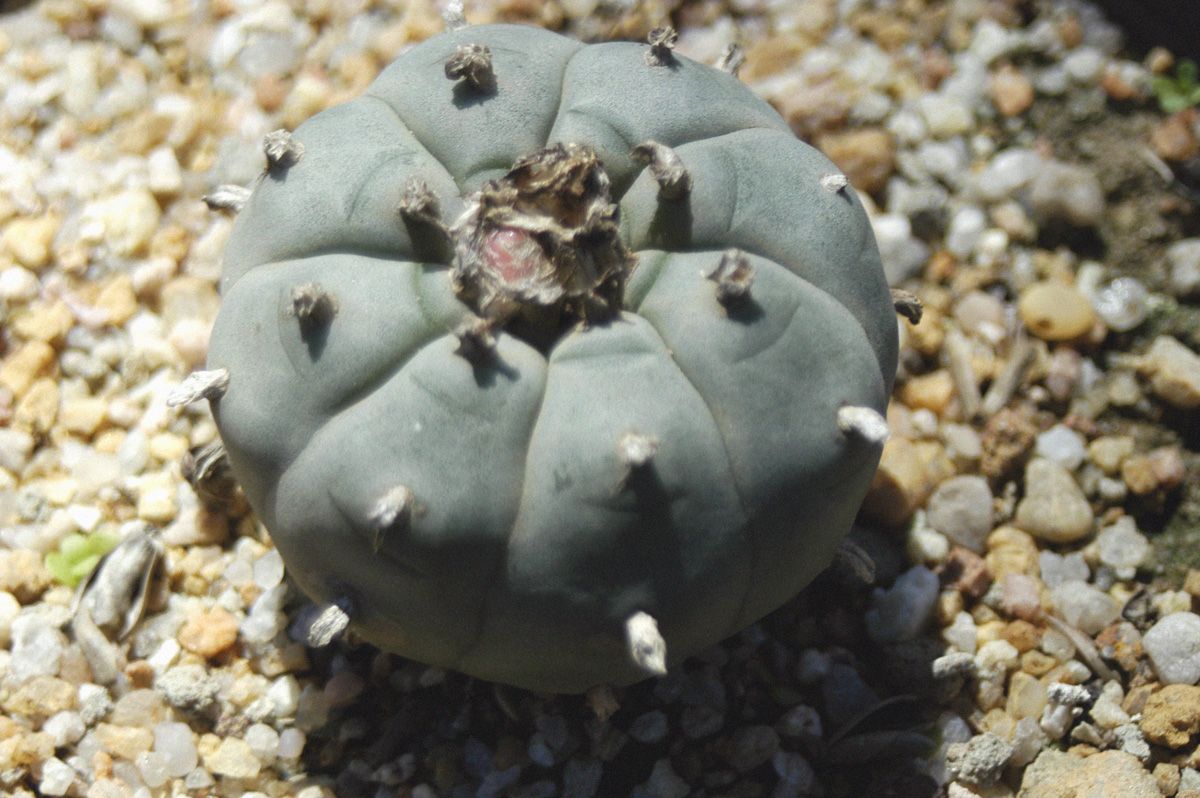
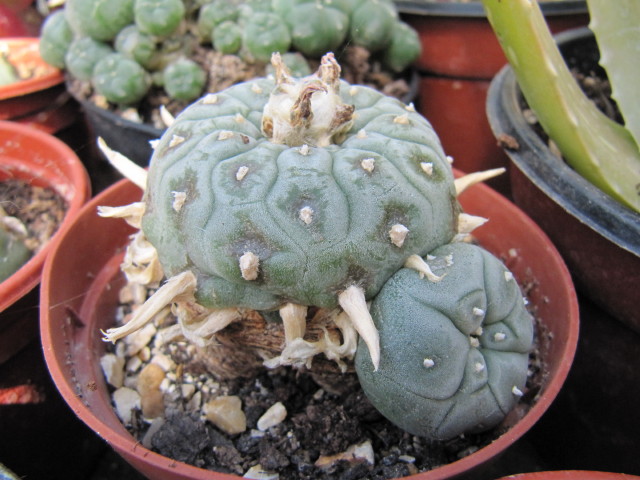
In L. williamsii the tubercles are usually arranged as distinct ribs or as elevated podaria. [Structure, Development, and Taxonomy in the Genus Lophophora]
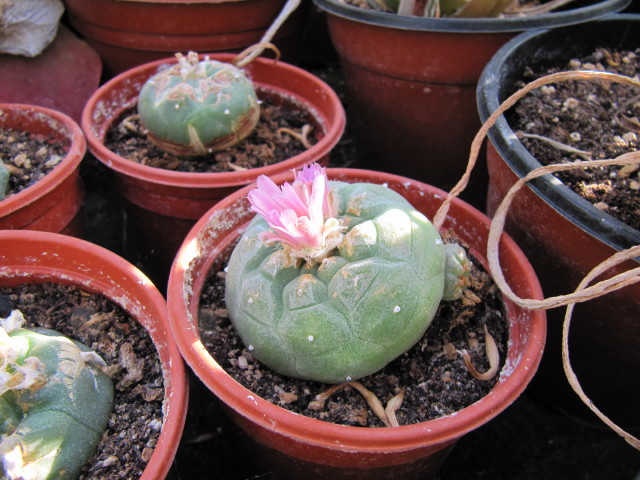
Flower color in the northern population (L. williamsii) is usually pink but occasionally white, sometimes appearing yellowish. [Structure, Development, and Taxonomy in the Genus Lophophora]
L. williamsii normally shows sharply demarcated, raised ribs with no horizontal folds of tissue running perpendicular to the ribs around the base of the stem. [Terry 2008 CSJ 80 part 1 (Lophophora taxonomy)]
The Miquihuana, Tamaulipas population is distinctive: virtually 100% of the plants are caespitose (clump-forming), and they begin sprouting lateral branches as seedlings, whereas plants in other Lophophora populations generally begin such branching only after reaching maturity, if at all. [Terry, M. Stalking the wild Lophophora, Part 2: Zacatecas, San Luis Potosi, Nuevo Leon, and Tamaulipas. Cactus and Succulent Journal, Vol. 80, No. 5, September-October 2008.]
The northern (South Texas 'Peyote Gardens') L. williamsii plants are autogamous (self-fertile), whereas greenhouse observations suggest the Miquihuana plants, like those of El Huizache to the south, are obligate outcrossers (self-sterile). [Terry, M. Stalking the wild Lophophora, Part 2: Zacatecas, San Luis Potosi, Nuevo Leon, and Tamaulipas. Cactus and Succulent Journal, Vol. 80, No. 5, September-October 2008.]
The accepted name with authority is Lophophora williamsii (Lem. ex J.F.Cels) J.M.Coult., in family Cactaceae; its common name is peyote. [Klein et al 2015 Haseltonia 20:34-42]
Scanning electron microscope images of L. williamsii testa show predominantly elongated testa cells with cuticular folding running transverse to the cell boundaries. [Hansen 2000 — Lophophora fricii & williamsii var. decipiens]
An alternative classification by Grym (1997) is noted, treating the genus as a single species Lophophora williamsii with four varieties: var. williamsii, var. diffusa, var. koehresii, and var. fricii. [Hansen 2000 — Lophophora fricii & williamsii var. decipiens]
The species is also cited in the literature under abbreviated or informal authority forms such as Lophophora williamsii (Lem.) Coulter and Lophophora williamsii Lem. Coulter; the accepted authority is (Lem. ex J.F.Cels) J.M.Coult. [Conservation Status, Germination, and Establishment of the Divine Cactus, Lophophora williamsii (Lem. ex Salm-Dyck) J. M. Coult., at Cuatro Ciénegas]
There are several studies on the taxonomy of the species, but studies on its ecology are rare and very little is known about its natural populations. [Conservation Status, Germination, and Establishment of the Divine Cactus, Lophophora williamsii (Lem. ex Salm-Dyck) J. M. Coult., at Cuatro Ciénegas]
Most horticultural Lophophora names (e.g., L. echinata, L. jourdaniana, L. decipiens) are currently unaccepted by most experts as specific taxonomic nomenclature. [Trout's Notes on the Cultivation & Propagation of Cacti]
Lophophora williamsii has the full authority '(Lem. ex J.F.Cels) J.M.Coult.', being a recombination of the basionym Echinocactus williamsii Lem. ex J.F.Cels. [https://powo.science.kew.org/taxon/urn:lsid:ipni.org:names:143606-2]
Homotypic synonyms of L. williamsii include Anhalonium williamsii (Lem. ex J.F.Cels) C.F.Först., Ariocarpus williamsii (Lem. ex J.F.Cels) Voss, Echinocactus williamsii Lem. ex J.F.Cels (the basionym), Lophophora williamsii var. typica Croizat, and Mammillaria williamsii (Lem. ex J.F.Cels) J.M.Coult. [https://powo.science.kew.org/taxon/urn:lsid:ipni.org:names:143606-2]
POWO lists roughly 30 heterotypic synonyms of L. williamsii, including names such as Lophophora lewinii and Lophophora echinata, indicating a long history of taxonomic splitting that has since been lumped into this species. [https://powo.science.kew.org/taxon/urn:lsid:ipni.org:names:143606-2]
A 2023 nomenclatural review (Calvo, TAXON) showed the basionym Echinocactus williamsii was first validly described by French horticulturist Jean Francois Cels in 1842, predating Salm-Dyck's 1845 description; Kew/POWO and IPNI now cite the accepted name as Lophophora williamsii (Lem. ex J.F.Cels) J.M.Coult. rather than the older (Lem. ex Salm-Dyck) J.M.Coult. form. [https://onlinelibrary.wiley.com/doi/abs/10.1002/tax.12979; https://www.ipni.org/n/87800-2; https://powo.science.kew.org/taxon/urn:lsid:ipni.org:names:143606-2]
Phylogenetics — the DNA story
In stem morphology and color, the Miquihuana, Tamaulipas plants strongly resemble the plants of the 'Peyote Gardens' of South Texas about 300 km to the north, but in breeding system they appear more closely allied to the populations around El Huizache about 120 km to the south. [Terry, M. Stalking the wild Lophophora, Part 2: Zacatecas, San Luis Potosi, Nuevo Leon, and Tamaulipas. Cactus and Succulent Journal, Vol. 80, No. 5, September-October 2008.]
Light requirement for germination is phylogenetically constrained in the tribes Cacteae and Pachycereeae, with Lophophora williamsii (tribe Cacteae) being positive photoblastic (requiring light to germinate). [Conservation Status, Germination, and Establishment of the Divine Cactus, Lophophora williamsii (Lem. ex Salm-Dyck) J. M. Coult., at Cuatro Ciénegas]
Native range
L. williamsii (the northern population) ranges from Texas along the Rio Grande south to San Luis Potosi in Mexico. [Structure, Development, and Taxonomy in the Genus Lophophora]
Field collections for the study included a site near Shafter, Texas, about 6 miles north on U.S. Highway 67, along the Rio Grande region. [Structure, Development, and Taxonomy in the Genus Lophophora]
The Sierra de la Amargosa region of Chihuahua was noted a century ago by Lumholtz (1902) as an area to which the Tarahumara traditionally traveled from their homelands to harvest hikuli (L. williamsii). [Terry 2008 CSJ 80 part 1 (Lophophora taxonomy)]
A population of L. williamsii occurs near Miquihuana on the western edge of Tamaulipas, at about the same latitude as Ciudad Victoria on the opposite side of the Sierra Madre Oriental. [Terry, M. Stalking the wild Lophophora, Part 2: Zacatecas, San Luis Potosi, Nuevo Leon, and Tamaulipas. Cactus and Succulent Journal, Vol. 80, No. 5, September-October 2008.]
It is a widespread species of the Chihuahuan Desert, growing on both banks of the Rio Grande and in scattered places across Mexico. [Conservation Status, Germination, and Establishment of the Divine Cactus, Lophophora williamsii (Lem. ex Salm-Dyck) J. M. Coult., at Cuatro Ciénegas]
The native range of L. williamsii is southwestern and southern Texas (USA) to northeastern Mexico, extending south to about Jalisco; it occurs in the Chihuahuan Desert in the Mexican states of Coahuila, Nuevo Leon, San Luis Potosi, Tamaulipas, and Zacatecas. [https://powo.science.kew.org/taxon/urn:lsid:ipni.org:names:143606-2; https://cactusconservation.org/cci-research/lophophora/]
Lophophora williamsii ranges from southwestern and southern Texas (USA) into northeastern Mexico, extending as far south as Jalisco, per Plants of the World Online (Kew): native range stated as 'SW. & S. Texas to NE. Mexico (to Jalisco)'. [https://powo.science.kew.org/taxon/urn:lsid:ipni.org:names:143606-2/general-information]
In the United States the species occurs only in Texas; in Mexico it grows across several central and northern states including Chihuahua, Coahuila, Nuevo Leon, Durango, Tamaulipas, Zacatecas and San Luis Potosi, in a band stretching from the Chihuahuan Desert to the South Texas Plains on both sides of the middle and lower Rio Grande. [https://www.llifle.com/Encyclopedia/CACTI/Family/Cactaceae/1117/Lophophora_williamsii; https://unitedplantsavers.org/peyote-lophophora-williamsii-2/]
Within Texas, extensive stands occur on low rocky hills in Starr, Zapata, Webb, and Jim Hogg counties of South Texas, with separate occurrences in West Texas. [https://unitedplantsavers.org/peyote-lophophora-williamsii-2/; https://www.biorxiv.org/content/10.1101/2020.04.03.023515v1.full]
Habitat
L. williamsii normally prefers limestone or calcareous soils; igneous rock geology (as found in the hills west of Chihuahua City) is considered unsuitable, making peyote occurrence there extremely unlikely. [Terry 2008 CSJ 80 part 1 (Lophophora taxonomy)]
The Miquihuana, Tamaulipas population of L. williamsii grows among small agaves and Larrea (creosote bush); plants are multi-stemmed and grow in a relatively dense stand. [Terry, M. Stalking the wild Lophophora, Part 2: Zacatecas, San Luis Potosi, Nuevo Leon, and Tamaulipas. Cactus and Succulent Journal, Vol. 80, No. 5, September-October 2008.]
It is a low, flat-to-domed spineless cactus with a chlorophyllous crown and substantial non-chlorophyllous stem and taproot. [Klein et al 2015 Haseltonia 20:34-42]
In the wild it occurs most frequently on limestone hills and in other calcareous soils, at elevations from 50 to 1850 m above sea level (citing Anderson 1996). [Klein et al 2015 Haseltonia 20:34-42]
Mescaline is produced in the chlorophyll-containing parenchyma (chlorenchyma) cells of the crown tissue (citing Janot and Bernier 1933), which explains why most of the alkaloid is concentrated in the crown. [Klein et al 2015 Haseltonia 20:34-42]
It generally thrives on calcareous soils in desert (arid) environments of the Chihuahuan Desert. [Conservation Status, Germination, and Establishment of the Divine Cactus, Lophophora williamsii (Lem. ex Salm-Dyck) J. M. Coult., at Cuatro Ciénegas]
It tends to grow in the shade of shrubs through a facilitation interaction called the nurse plant effect; documented nurse plants include Prosopis spp., Acacia farnesiana, Mimosa biuncifera, Agave lechuguilla, Jatropha dioica, and Euphorbia antisyphilitica. [Conservation Status, Germination, and Establishment of the Divine Cactus, Lophophora williamsii (Lem. ex Salm-Dyck) J. M. Coult., at Cuatro Ciénegas]
It coexists with other succulent plants such as Ariocarpus retusus, Coryphantha sp., Echinocactus horizonthalonius, E. platyacanthus, Ferocactus sp., Hechtia glomerata, and Mammillaria spp. [Conservation Status, Germination, and Establishment of the Divine Cactus, Lophophora williamsii (Lem. ex Salm-Dyck) J. M. Coult., at Cuatro Ciénegas]
As a succulent desert plant its roots sometimes extend only to a depth of about 0.1 m, making near-surface soil humidity very important; water scarcity and predation are the factors causing the highest mortality in cacti seedlings. [Conservation Status, Germination, and Establishment of the Divine Cactus, Lophophora williamsii (Lem. ex Salm-Dyck) J. M. Coult., at Cuatro Ciénegas]
In far west Texas, peyote grows in open rocky country on slopes, ridges, and hills, and in river valleys, usually on calcareous soils, often in full sun or under plants such as Larrea, Opuntias, Jatropha, Lechuguilla, Candelilla, and Selaginella. [Trout's Notes on the Cultivation & Propagation of Cacti]
Peyote tolerates a variety of soils, all variations on calcium-rich alluvial loams with abundant silicate gravels and relatively low organic content; Cactus Conservation Institute soil tests of five wild Texas populations found organic content ranging from 5 to 16 percent. [Trout's Notes on the Cultivation & Propagation of Cacti]
In south Texas, peyote most frequently grows in dense thorny scrub brush at the base of thorny bushes; seedlings on open rocky slopes start in cracks between rocks or next to surface roots for protection from sun and water runoff. [Trout's Notes on the Cultivation & Propagation of Cacti]
It grows primarily in the desert or dry shrubland biome, where it associates with nurse/facilitator shrubs in rosetophyllous desert scrub. [https://powo.science.kew.org/taxon/urn:lsid:ipni.org:names:143606-2/general-information; https://www.sciencedirect.com/science/article/abs/pii/S0140196322001197]
Growing & propagation
Adventitious buds form beneath wounds following decapitation, and in many plants clusters of heads (a caespitose habit) form below the crown, accounting for the multi-headed clumping seen in cultivated and wild plants. [Structure, Development, and Taxonomy in the Genus Lophophora]
The plant can be sustainably harvested by transversely cutting off the crown at its base, usually at or near ground level; properly harvested plants usually regrow new crowns within a few months by axillary branching from areolar buds on the non-chlorophyllous stem. [Klein et al 2015 Haseltonia 20:34-42]
The only parts capable of producing new branches are the crown (aerial chlorophyllous stem) and the non-chlorophyllous stem; the lateral stem branches eventually develop their own adventitious roots and become independent clones (ramets) of the parent plant as the parent degenerates (citing Terry and Mauseth 2006). [Klein et al 2015 Haseltonia 20:34-42]
Removal of the crown removes the apical meristem and its auxin secretion, which de-represses dormant axillary buds in the areoles of the non-chlorophyllous stem, causing them to develop into new axillary branches, each forming its own crown and adventitious taproot. [Klein et al 2015 Haseltonia 20:34-42]
If too much of the non-chlorophyllous stem is removed with the crown, all functional areoles are lost, leaving no axillary buds capable of regrowth; this is a primary cause of post-harvest mortality (citing Terry and Mauseth 2006). [Klein et al 2015 Haseltonia 20:34-42]
Increased mortality in previously harvested plants versus unharvested controls has been documented in the field, with slow death resulting from failure to regrow quickly enough under repeated harvesting at two-year intervals (citing Terry et al. 2011, 2012). [Klein et al 2015 Haseltonia 20:34-42]
The authors propose changing terminology from 'subterranean stem' to 'non-chlorophyllous stem' because part of that stem may sometimes be exposed above ground in the plant's natural habitat, where erosion and gravel redistribution from torrential rains can expose several centimeters of it. [Klein et al 2015 Haseltonia 20:34-42]
Sustainable root harvesting would become feasible in cultivation, in contrast to wild populations where removing the root is unsustainable. [Klein et al 2015 Haseltonia 20:34-42]
Cultivating peyote in nurseries to satisfy collectors can aid conservation and decrease pressure on wild populations; the authors call for urgent revision of regulations to allow cultivation. [Conservation Status, Germination, and Establishment of the Divine Cactus, Lophophora williamsii (Lem. ex Salm-Dyck) J. M. Coult., at Cuatro Ciénegas]
Peyote seeds remain viable for several years and survive storage at room temperature (20 ± 2 °C), with germination decay of up to about 25% indicating a loss of viability process. [Conservation Status, Germination, and Establishment of the Divine Cactus, Lophophora williamsii (Lem. ex Salm-Dyck) J. M. Coult., at Cuatro Ciénegas]
In germination experiments at 25 °C with a 12:12 h light-darkness photoperiod, overall germination was 64%; one-year-old seeds germinated at the highest rate (78.13%) and nine-year-old seeds at the lowest (12.5%). [Conservation Status, Germination, and Establishment of the Divine Cactus, Lophophora williamsii (Lem. ex Salm-Dyck) J. M. Coult., at Cuatro Ciénegas]
Flowers are red to pink or white (rarely yellow), 1-2.4 cm long and 1-2.2 cm in diameter, borne on apical areolae; the plants at Cuatro Ciénegas have pink flowers. Flowering begins when plants are still small, occurring chiefly June-July and more broadly March-September. [Conservation Status, Germination, and Establishment of the Divine Cactus, Lophophora williamsii (Lem. ex Salm-Dyck) J. M. Coult., at Cuatro Ciénegas]
The fruit is a naked claviform berry, red or pinkish, 15-20 mm long and 2-3.4 mm in diameter, which matures and emerges quickly from the woolly apex and remains partially contained within the hairs of the apical depression; in San Luis Potosí fructification was recorded July-September. [Conservation Status, Germination, and Establishment of the Divine Cactus, Lophophora williamsii (Lem. ex Salm-Dyck) J. M. Coult., at Cuatro Ciénegas]
The species can form colonies (though solitary individuals occur), and its small seed size aids burial into the soil substrate as a strategy against predation; despite features needed for soil seed banks, high predation pressure in natural conditions may prevent forming even a transient seed bank. [Conservation Status, Germination, and Establishment of the Divine Cactus, Lophophora williamsii (Lem. ex Salm-Dyck) J. M. Coult., at Cuatro Ciénegas]
Peyote needs agricultural limestone, gypsum, and/or dolomite mixed into the soil (about a heaping tablespoon per gallon) to allow flowering, prefers partial or filtered sun, and should be kept on the dry side. [Trout's Notes on the Cultivation & Propagation of Cacti]
Growing peyote is not advised where winter extremes routinely reach the teens; plants tolerate cold and wet into the upper 20s F but extended winter moisture stresses them, and one Austin specimen survived 6 degrees F several times over 35-plus years with only an ice-storm blanket. [Trout's Notes on the Cultivation & Propagation of Cacti]
Grafting Lophophora williamsii (e.g., onto Pereskiopsis, San Pedro, or Cereus pitajaya per FUJITA et al. 1972) accelerates growth, induces clumping, and brings plants to flowering size in a year to 18 months per ANDERSON 1980 (cited), greatly increasing seed production. [Trout's Notes on the Cultivation & Propagation of Cacti]
History
The Miquihuana, Tamaulipas population was examined by Ted (Edward F.) Anderson in his PhD thesis (Anderson 1961, A Taxonomic Revision of Ariocarpus, Lophophora, Pelecyphora, and Obregonia, Claremont Graduate School). [Terry, M. Stalking the wild Lophophora, Part 2: Zacatecas, San Luis Potosi, Nuevo Leon, and Tamaulipas. Cactus and Succulent Journal, Vol. 80, No. 5, September-October 2008.]
Peyote has been harvested and used by humans for at least 6,000 years (citing Terry et al. 2006). [Klein et al 2015 Haseltonia 20:34-42]
Historically the plant was used by native peoples as a medicine (citing Schultes 1938, 1940) and for religious purposes (citing Stewart 1987). [Klein et al 2015 Haseltonia 20:34-42]
The CM-79 burial cave near Cuatrocienegas, Coahuila is the only known archaeological site where identifiable peyote buttons have been found; eight buttons strung on cordage from this site are about 1,000 years old (citing Terry et al. 2006). [Klein et al 2015 Haseltonia 20:34-42]
The approximately 1,000-year-old CM-79 buttons show classic traditional harvesting of crowns only, with no non-chlorophyllous stem or root attached, exemplifying sustainable harvesting by the region's prehistoric inhabitants. [Klein et al 2015 Haseltonia 20:34-42]
Even in traditional Huichol harvesting using a digging stick, efforts are typically made to return the root to the earth. [Klein et al 2015 Haseltonia 20:34-42]
Licensed peyote distributors ('peyoteros') have harvested and distributed about 1.4 to 2.3 million peyote tops ('buttons') per year for the last quarter century in South Texas (Texas Department of Public Safety unpublished data). [Klein et al 2015 Haseltonia 20:34-42]
Peyote was noticed by the Spaniards from 1560, and 17th-century Jesuit missionaries testified that Mexican indigenous people used it for ceremonial and medicinal purposes; Spanish efforts to exterminate the practice displaced the cult toward the mountains, where it persists. [Conservation Status, Germination, and Establishment of the Divine Cactus, Lophophora williamsii (Lem. ex Salm-Dyck) J. M. Coult., at Cuatro Ciénegas]
The plant is culturally valued by Tarahumaras, Huicholes, Coras and other Mexican cultures, and by members of the Native American Church in the USA and Western Canada; a special legal regime regulates and permits its use by native tribes, while other possession is a federal offense. [Conservation Status, Germination, and Establishment of the Divine Cactus, Lophophora williamsii (Lem. ex Salm-Dyck) J. M. Coult., at Cuatro Ciénegas]
Conservation
The Miquihuana, Tamaulipas population is rather small; local people value it greatly and harvest it sustainably for therapeutic use, particularly as a topical analgesic for sore muscles, and requested that its location not be divulged to reduce the risk of decimation. [Terry, M. Stalking the wild Lophophora, Part 2: Zacatecas, San Luis Potosi, Nuevo Leon, and Tamaulipas. Cactus and Succulent Journal, Vol. 80, No. 5, September-October 2008.]
In the US, L. williamsii is a DEA Schedule I substance; unlicensed possession of any part of L. williamsii, including its seeds, carries non-trivial criminal penalties, and peyote tissue has not legally been imported from Mexico into the US in the last 35 years (as of 2008). [Stalking the wild Lophophora Part 3 (Cactus and Succulent Journal 2008, Volume 80, Number 6)]
It is a North American cactus threatened with extinction due to over-collection; it is always taken from the wild, so the species is now depleted from several areas and many populations along its distribution range no longer exist. [Conservation Status, Germination, and Establishment of the Divine Cactus, Lophophora williamsii (Lem. ex Salm-Dyck) J. M. Coult., at Cuatro Ciénegas]
Human activities and constant collection of specimens have considerably reduced the number of individuals or altered the life form of peyote populations in several localities in Texas and Mexico. [Conservation Status, Germination, and Establishment of the Divine Cactus, Lophophora williamsii (Lem. ex Salm-Dyck) J. M. Coult., at Cuatro Ciénegas]
Although the Cuatro Ciénegas Basin holds well-preserved populations, they may be threatened by biological and anthropogenic factors, making future conservation efforts urgent. [Conservation Status, Germination, and Establishment of the Divine Cactus, Lophophora williamsii (Lem. ex Salm-Dyck) J. M. Coult., at Cuatro Ciénegas]
Natural populations can be rehabilitated or aided by sowing seeds or reintroducing specimens, which requires information on germination requirements and establishment conditions. [Conservation Status, Germination, and Establishment of the Divine Cactus, Lophophora williamsii (Lem. ex Salm-Dyck) J. M. Coult., at Cuatro Ciénegas]
Collected seeds can be stored for several years under laboratory conditions, and the species has the potential to maintain a persistent seed bank that may dampen over-collection in natural populations. [Conservation Status, Germination, and Establishment of the Divine Cactus, Lophophora williamsii (Lem. ex Salm-Dyck) J. M. Coult., at Cuatro Ciénegas]
Peyote habitat is being destroyed at an alarming rate with commonplace deliberate root harvests in Mexico and the USA, and legitimate collectors supplying the Native American Church are harvesting plants too young to have ever flowered (often less than dime-sized), threatening wild population reproduction. [Trout's Notes on the Cultivation & Propagation of Cacti]
The IUCN Red List assesses Lophophora williamsii as Vulnerable; the current assessment (e.T151962A121515326) was authored by M. Terry, a 2017 amended version of a 2013 assessment. [https://explorer.natureserve.org/Taxon/ELEMENT_GLOBAL.2.139920/Lophophora_williamsii; https://en.wikipedia.org/wiki/Peyote]
Main threats to wild L. williamsii are habitat destruction and unsustainable harvesting; in Mexico it is subject to special protection (NOM-059) and listed as at risk of extinction, whereas it has no specific state or federal conservation protection in the United States. [https://cactusconservation.org/cci-research/lophophora/; https://unitedplantsavers.org/species-at-risk-list/peyote-lophophora-williamsii-2/]